

The Confidence to Be a Beginner Again
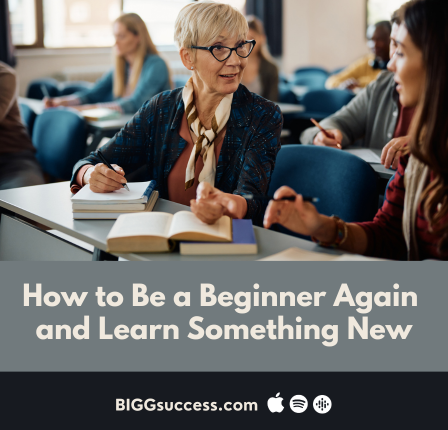
What if your next level requires becoming a beginner again? In episode #1210 of The BIGG Success Show, learn how to start small, experiment and build confidence along the way.
Subscribe: Apple Podcasts | Spotify | More
[GK] As a professor, I spend a lot of time around beginners.
Every semester, students walk into a classroom to learn things they don’t already know. They ask questions. They make mistakes. They get answers wrong.
And we expect that. They’re learning.
But, as every true learner comes to know, something changes as we become successful.
We get used to knowing what we’re doing.
We build expertise. People come to us for answers. We earn credentials, titles, clients, promotions – or simply a reputation for being good at what we do.
Why It Gets Harder to Be a Beginner
Then an interesting opportunity comes along. A new technology. A different career. A business idea. A creative pursuit. A new role.
You’re intrigued. There’s just one problem: You won’t be very good at it at first.
Once you’re known for being competent, voluntarily stepping into a new place where you aren’t can feel surprisingly risky.
Learning expert Eduardo Briceño, author of The Performance Paradox, describes the difference between the performance zone, where we use abilities we’ve already developed to produce results, and the learning zone, where we experiment, make mistakes, get feedback, and improve.
The performance zone helps us succeed today. The learning zone helps us get better for tomorrow. And successful people need both.
So here’s our question for today:
Have you become so comfortable being good at what you do that you’re afraid to be a beginner again? Or, asked another way: Are you willing to be bad at something new long enough to get good at it?
In this episode we’ll explore:
- How to choose where becoming a beginner is worth it
- Why small experiments make starting easier
- How to turn beginner mistakes into useful learning
- When to expand a new skill into a bigger opportunity
We’ll start with four steps to becoming a beginner with confidence: Choose. Experiment. Learn. Expand.
Step 1 CHOOSE: Make Sure It’s Worth Learning
You don’t have enough time to become a beginner at everything that interests you. So when something new catches your attention, ask: “If I became good at this, would it meaningfully improve the life I want?”
Maybe it could increase your income or open a new career path. Perhaps it would help your business, improve your health, strengthen an important relationship, or give you a creative outlet you’ve always wanted.
The answer gives you a reason to tolerate the discomfort of being new. It also explains why having a Life Map is so valuable.
When you know where you want to go personally, professionally, and financially, opportunities become easier to evaluate. You can ask whether this new skill moves you toward the life you want. Or simply distracts you from it.
Researcher Erik Dane has written about cognitive entrenchment – how deep expertise can sometimes make us less flexible in our thinking. Experience is an enormous asset. But yesterday’s expertise can become a limitation if we refuse to add anything new to it.
So choose carefully. Then give yourself permission to begin.
Step 2 EXPERIMENT: Make the First Step Smaller
We often make becoming a beginner harder than necessary.
- You’re interested in entrepreneurship, and suddenly you’re asking whether you should quit your job.
- You want to write, and you’re already thinking about publishing a book.
- You’re curious about a new career, and you imagine starting your entire professional life over.
That’s a lot of pressure to put on curiosity!
Instead, ask: “What small experiment could help me learn whether this deserves more of my time?” (We discuss this more in Episode #1202 How to Know What Opportunities to Say No To.)
To experiment with small steps:
- Freelance before starting a company.
- Publish a few articles before writing a book.
- Volunteer for a project before changing careers.
- Try a new technology on one task before changing your whole workflow.
Small experiments give you real information without requiring a huge commitment. They also give you something successful people often need: a protected place to be bad.
– Practice before you perform.
– Test before you launch.
– Try before you announce.
Your first attempt at something new doesn’t have to meet the standards of something you’ve practiced for 20 years. Give yourself room to be unimpressive for a while.
Step 3 LEARN: Stop Turning Results Into Identity
Here comes the uncomfortable part. You try the thing. And you’re bad at it. Welcome to learning!
This is where accomplished people sometimes get tripped up. We take one poor result and make it personal.
“I’m terrible at this.”
“I’m too old for this.”
“I don’t have the talent anymore.”
Instead, ask: “What did this attempt teach me?”
Maybe you need more practice, better instruction, a different approach, or a smaller next step. Or perhaps you discover that this opportunity really isn’t right for you. That’s useful information too. A poor first attempt tells you very little about what your hundredth attempt could look like.
This allows you to redefine confidence. Confidence doesn’t have to mean: “I know I’ll be good at this.” Instead, it tells you: “I trust myself to learn.”
That kind of confidence travels with you. You can ask questions. Get help. Practice. Accept feedback. Adjust. Improve. You don’t need certainty before you move forward.
Step 4 EXPAND: Combine the New With What You Already Know
Something interesting happens if you stay with the process. Eventually, you’re not quite such a beginner anymore!
Now ask: “What could this new capability make possible?”
New skills become especially powerful when combined with old expertise. That looks like:
- An experienced professional who learns AI becomes an experienced professional with a powerful new tool.
- A subject-matter expert who learns video gains a new way to share that expertise.
- An employee who learns entrepreneurship may begin seeing business opportunities in problems they’ve observed for years.
Your previous experience doesn’t disappear when you become a beginner. You add to it! And sometimes that combination opens a door you couldn’t have seen before.
That’s why your Life Map should provide direction without locking you into one route. As you grow, you learn. As you learn, new possibilities appear.
When an experiment shows promise, go deeper. Choose. Experiment. Learn. Expand.
Then be willing to begin again.
BIGG Assignment
Create your own Beginner Permission Slip.
Complete these four sentences:
1. Something I would like to learn but have been reluctant to try is __________.
2. I’ve been hesitant to begin because I’m afraid __________.
Be specific. Are you afraid of looking foolish? Wasting time? Discovering you aren’t naturally good at it?
3. For the next 30 days, I give myself permission to be bad at __________.
You’re not promising mastery. You’re giving yourself permission to learn.
4. At the end of 30 days, ask: Did I learn enough to know whether I want to continue?
An important goal with this assignment: Don’t judge yourself on how good you became. Judge the experiment on what you learned.
BIGG Takeaway
Success gives you something incredibly valuable: competence. Just don’t let competence become a cage.
The life you want next may require a skill you haven’t developed, a question you don’t know how to answer, or something you’ll be pretty bad at when you start.
So remember: Your next level may require giving yourself permission to be a beginner again. It leads to BIGG Success!
If you’re thinking about what your own “next level” should look like, our Life Map Course can help you connect your personal, professional, and financial goals into one clear direction – or you can decide which opportunities deserve your time and energy. Learn more at LifeMapCourse.com.
Want more practical ideas for creating the life you want? Join our newsletter and get our latest insights delivered right to you.
Next episode: Think about something you’ve invested time, energy, or money into. How do you know whether to keep going, or finally let it go? That’s next time on BIGG Success.
Follow or subscribe to the BIGG Success Show wherever you listen to podcasts so you don’t miss our next episode.
Here’s to your BIGG success!
George “The Professor” & Mary-Lynn

Co-Founders, BIGG Success
P.S.
What’s something new you are willing to be bad at long enough to get good at it?


